
Russian President Vladimir Putin has proposed a new investment platform, based on the New Development Bank (NDB), to fund projects in trade, infrastructure, logistics, and technology across BRICS nations, emphasising that the grouping's expanding economic cooperation is not 'against anyone' but aims to advance members' national interests.

SCTIMST and Invasive Technologies have launched "Chitra Core," a new drug-eluting coronary stent designed with significantly less metal to reduce complications. This indigenous innovation, developed in collaboration, aims to provide advanced and cost-effective cardiac care, building on decades of Indian medical device development. The institute is also developing a unique TiN-coated stent for global markets.

One of the important topics of discussion between the two leaders is expected to be the Northern Sea Route and the Chennai-Vladivostok Maritime Corridor.

Prime Minister Narendra Modi on Sunday used two major public engagements in Kolkata to outline a broader vision for India's future -- one rooted in inner balance and collective well-being through yoga, and the other in national self-reliance and maritime strength.

The UK has successfully test-fired a US torpedo from an undersea drone, marking a significant advancement in submarine technology for the AUKUS partners (UK, US, Australia). This development coincides with Prime Minister Andy Burnham's visit to the UN General Assembly, where he is discussing global challenges like AI, the Ukraine conflict, and West Asia security with international leaders, and announced the UK will host the G20 Leaders' Summit in Manchester next November.

The highlight of the successful BRICS Summit was its ability to deliver a joint statement that all members, including Iran and the United Arab Emirates, embroiled in the war in West Asia, signed.

The political confidence required to place high-end Japanese aircraft and personnel on Indian soil is itself a data point.
It indicates a level of trust that would have been difficult to imagine when India-Japan defence ties were largely symbolic, explains Varun Arya.

Prime Minister Narendra Modi, addressing the BRICS summit, called for a fundamental shift in global governance, advocating for the replacement of the current 'pyramid of privilege' with a 'platform of partnership' where the Global South becomes a 'rule shaper' rather than a 'rule follower'.

A drone boat, co-founded by Indian-American Vibhav Altekar, successfully rescued two crew members of a downed US Army Apache helicopter near the Strait of Hormuz, marking a first-of-its-kind autonomous surface vessel rescue for the US Armed Forces.

Experts' worries intensified after Pakistan commissioned its first Chinese-built Hangor-class submarine, PNS Hangor, last month.

Notwithstanding the economic complementarities and the host of agreements for deepening economic relation on a host of areas, both sides share common viewpoints on the foreign policy domain and seek common grounds to serve as a counterweight to China, notes Dr Rajaram Panda.

Modi's comments on underlining the importance of ensuring the safety of seafarers came against the backdrop of growing anger in India over the killing of the three Indian crew members in a US military attack on a merchant ship off the coast of Oman last week.

'After we were alerted about the war, none of us could sleep for the next two nights while sailing through those waters.'

Gwadar is viewed as a critical pearl in China's maritime strategy as it would give a permanent logistical footprint near an important choke point - the Strait of Hormuz and the oil rich Persian Gulf, explains Commodore Venugopal Menon (retd).

Prime Minister Narendra Modi urged US President Donald Trump to prioritise the safety of Indian seafarers in the Strait of Hormuz during the implementation of Washington's proposed Iran peace deal, as both leaders focused on repairing strained bilateral relations at the G7 summit.

In response to the Quad ministers' joint statement, China on Tuesday said it opposes the creation of exclusive 'small cliques' and 'bloc confrontation'.

The Quad grouping has expanded cooperation in critical minerals and energy, while unveiling new measures to boost maritime surveillance and port infrastructure across the Indo-Pacific. This move comes against the backdrop of China's growing military posturing in the region, with ministers reiterating strong opposition to destabilising actions and expressing serious concerns over militarisation of disputed features.

Top commanders of the Indian Navy will discuss the implications of the West Asia crisis on India's energy security and review operational readiness at a three-day conference.

US President Donald Trump on Thursday said that he has directed the country's Navy to take decisive action against any vessels attempting to lay mines in the strategically vital Strait of Hormuz amid escalating tension over the virtual control of the waterway between Tehran and Washington.

In many ways, this is only the beginning -- of a new chapter in India's nuclear story, and of a future where its vast thorium reserves could finally power its ambitions.

In a region increasingly shaped by competition and coercion, such collaboration strengthens security without confrontation, builds capacity without dependency and promotes order without domination, points out Dr Kumar.
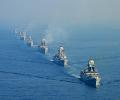
A parliamentary panel on external affairs has expressed concern over China's growing presence and influence in the Indian Ocean Region, citing risks to India's national security and strategic interests. The panel also highlighted the strengthening China-Pakistan naval nexus as a cause for concern.

China calls the shoal Huangyan Dao. China has already deployed some of its biggest CCG vessels in the area to assert its claims.

Equipped with torpedoes and anti-submarine rockets, the first of the Mahe-class anti-submarine warfare shallow water craft (ASW SWC) was delivered to the Navy on October 23.
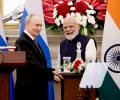
Russia, being bogged down by the Ukraine war and prioritising the requirements of its own armed forces, along with India's consistent diversification policy, will remain a major challenge to the bilateral partnership, note Harsh V Pant and Aleksei Zakharov.

The Russians have termed Putin's visit to India, his first to this country since the outbreak of the Russia-Ukraine war, as 'Druzhba Dosti', which means 'friendship' in Russian and Hindi respectively.
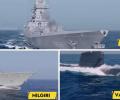
The Indian Navy has commissioned three new warships, INS Surat, INS Nilgiri, and INS Vaghsheer, marking a significant step in India's defense self-reliance and indigenous shipbuilding capabilities. These state-of-the-art vessels are designed and built entirely in India, showcasing the country's growing expertise in defense production. The commissioning of these warships strengthens India's position as a global leader in defense and augments its maritime strength.
Building an indigenous nuclear submarine will mark a leap forward in the country's defence preparedness considering that China already possesses such systems.
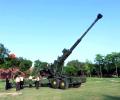
The Indian government outlines its futuristic defence programme, Sudarshan Chakra Mission, focusing on indigenous development, predictive technologies, and targeted counter-action systems to enhance national security.

A Liberian cargo ship carrying 640 containers, including 13 hazardous cargoes, has sunk off the coast of Kerala, raising concerns of environmental damage. The ship, MSC ELSA 3, capsized and sank in the early hours of May 25 after listing rapidly. The three remaining crew members were rescued by the Indian Navy. The Indian Coast Guard is monitoring the situation for any oil spills and has positioned a ship with pollution response equipment at the scene. The ship was carrying 84.44 MT of diesel and 367.1 MT of furnace oil, in addition to the hazardous cargo. The Kerala State Disaster Management Authority has cautioned the public against touching any cargo containers or oil spills that may wash ashore.
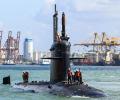
'There's an urgent requirement, particularly for the Indian Ocean region, as China's naval presence grows, and with Pakistan also acquiring more submarines.'

With this India joins the select group of countries which have a nuclear triad -- capable of delivering nuclear weapons by aircraft, ballistic missiles and submarine launched missiles.
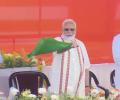
Prime Minister Narendra Modi inaugurated the Pamban sea bridge, providing rail link between Rameswaram island and the mainland and flagged off the new Rameswaram-Tambaram (Chennai) train service. The bridge is India's first vertical sea-lift bridge, spanning 2.08 kilometers, and includes a 72.5-meter-long vertical lift span that can be raised up to 17 meters, allowing the smooth passage of large ships while ensuring seamless train operations. Built at a cost of over Rs 550 crore, the bridge features stainless steel reinforcement, high-grade paint, and fully welded joints, enhancing durability while reducing maintenance requirements. The bridge is a remarkable blend of tradition and technology.
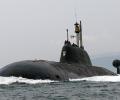
Calling for a rethink of its submarine building programme, Defence Minister Manohar Parrikar on Tuesday said India should look for greater numbers than the existing plan of constructing 24 such vessels.

From the seas to the stars, this partnership will now be deepened by the defining role of technology, the statement said.
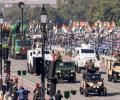
Under capital expenditure, Rs 48,614 crore has been set aside for aircraft and aero engines while Rs 24,390 crore has been allocated for the naval fleet.

Pakistan is allegedly working on an offensive chemical and biological warfare program with the help of its 'all-weather friend' China.

Designed and built by China State Shipbuilding Corporation Limited (CSSC), the frigate was delivered to the Pakistan Navy in a commissioning ceremony in Shanghai, according to Global Times.
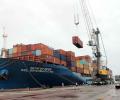
Industry associations and companies in the United States, including the US Chamber of Commerce, Coalition of Services Industries and the iconic bike company Harley Davidson have called on the Donald Trump dispensation to push India to reduce tariffs, non-tariffs, and regulatory barriers to boost American exports.
'He needs to see results while he is in office.'
